
Market Research
Andrei
Feb 9, 2026
Pricing has always been one of the trickiest decisions for businesses. Set it too low, and you leave money on the table. Set it too high, and you risk losing customers. That’s where the Gabor-Granger pricing method comes in, a proven approach that helps researchers and marketers identify how much customers are truly willing to pay before they walk away.
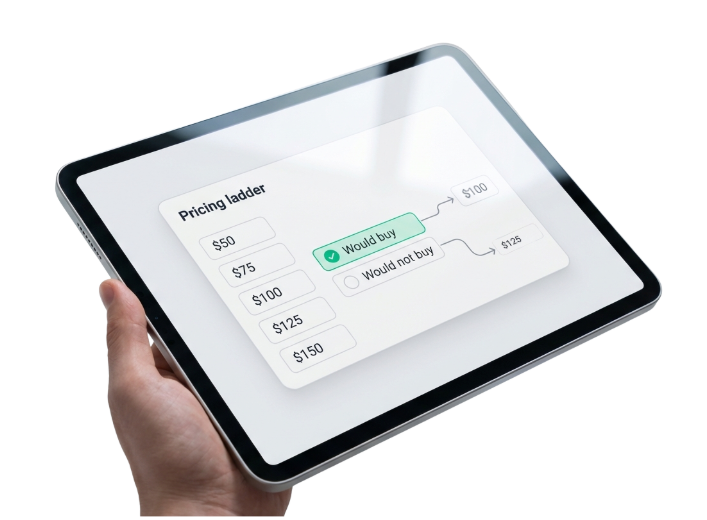
At its core, the Gabor-Granger method connects price with purchase intent. Instead of asking people to guess what they’d pay, it takes them through a structured set of yes/no questions:
This back-and-forth continues until the respondent’s maximum willingness to pay (WTP) is revealed. By isolating one price per screen, it avoids bias from comparisons and captures clean, reliable demand data.
The outcome? You don’t just learn if someone wants the product, you learn exactly at what price point they’re still in the game.
What makes the Gabor-Granger approach so valuable is the richness of insights that can be generated from these straightforward questions. Researchers can map out demand curves to see how interest falls as prices rise, and from there calculate revenue curves that highlight the point where revenue potential is at its peak. These curves reveal the precise price where customers begin to drop off and help identify how far a business can push pricing without jeopardizing too much demand. Often, the method uncovers surprising opportunities like cases where customers are willing to pay more than expected opening the door to higher profits. The simplicity of the method makes it possible to turn price questions into revenue answers, giving decision-makers confidence which is backed by evidence rather than assumptions.
So why, in 2026, do researchers still turn to Gabor-Granger? The answer is speed and clarity. It is quick to run, lightweight, and easy to interpret. It works particularly well for new product launches, where little pricing history exists, and for optimizing existing products where businesses want clarity without committing too complex, time-intensive studies. It is scalable, efficient, and powerful enough to spot potential revenue in a matter of days, making it a valuable tool for researchers who are often under pressure to deliver fast results.
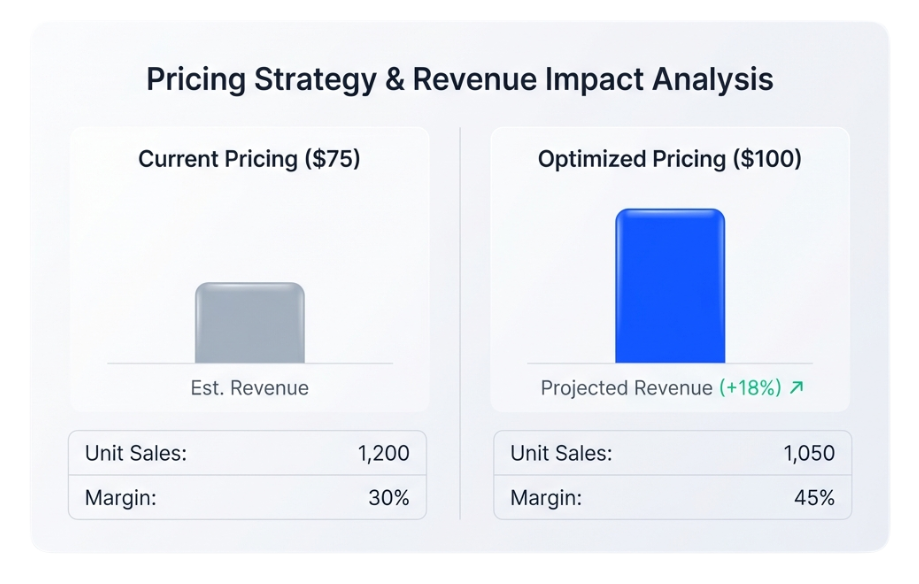
For instance, let's consider the case of a SaaS company which assumed that customers would only be willing to pay $75 per month. When researchers ran a Gabor-Granger study, they discovered that users were actually comfortable with a price point of $100. After validating this insight with A/B testing, the company raised its pricing and saw a significant lift in recurring revenue without harming conversion rates. Therefore, this simplifies a clear example of how the method avoids leaving money on the table and empowers businesses to make bold pricing moves with confidence.
Of course, no research method is perfect, and Gabor-Granger is no exception. It does not consider competitor pricing and is limited to evaluating one product or concept at a time. Because it measures intent rather than actual behavior, it cannot fully guarantee that respondents will follow through when faced with a real-world purchase decision. Even the choice of starting price can influence results if it isn’t carefully managed. And while the method reveals “how much” customers are willing to pay, it doesn’t explain “why” they value a product at that level.
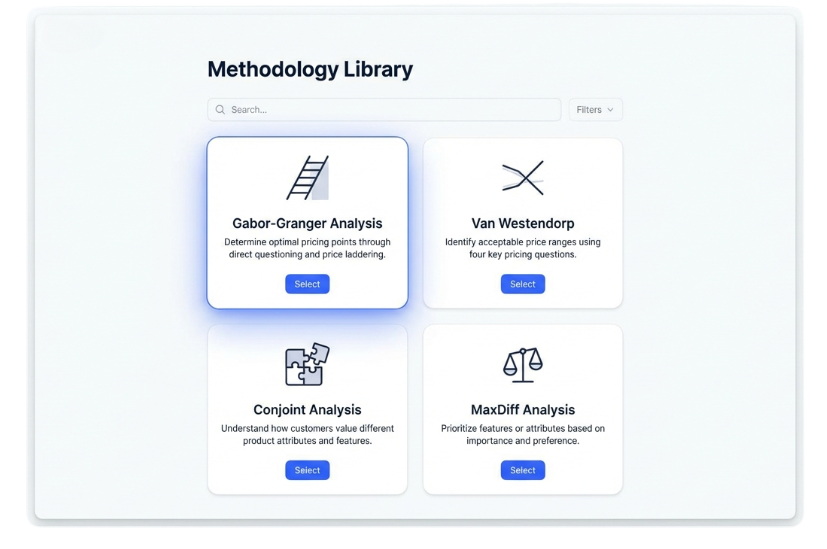
This is why researchers often pair Gabor-Granger with Van Westendorp and Cojoint analysis. Van Westendorp’s price sensitivity meter adds a psychological dimension by showing perceptions of what is too cheap, acceptable, or too expensive whereas conjoint analysis brings in a competitive lens, exploring how customers make trade-offs between features, benefits, and prices. When layered together, these methods provide a rich and clear picture to understand pricing strategy.
The Gabor-Granger pricing method is not just an outdated research method but is a vital part of the pricing toolkit today. By turning straightforward questions into powerful insights, it helps businesses move from uncertainty to clarity, from guesswork to strategy. In 2026 and beyond, researchers and marketers alike continue to rely on it as a fast, effective, and proven way to make smarter pricing decisions. Sometimes, the simplest methods are the ones that stand the test of time, and Gabor-Granger is a perfect example of that. Moreover, with modern survey platforms like Q-Fi, running these studies is faster and easier than ever.
%20(6).avif)
Market Research
Sakshi
Oct 22, 2025
Read full blog
.png)
Discover what’s possible with intuitive tools for surveys, communities, and reporting built for real research.

Built for research by research professionals.
Providing solutions to research agencies, marketing agencies, internal research teams, government, educational institutions, solo researchers and everyone in between.
Copyright ©2025 | Q-Fi Solutions Inc.


%20(8).avif)

.png)
